Macalester AAUP Chapter Annual Report, 2024-2025

As an inclusive and democratic organization, the Macalester Chapter of the American Association of  University Professors promotes academic freedom and shared governance on campus and advocates for  matters that concern the faculty. The history of the AAUP at Macalester goes back to the 1930s; the  current chapter was established in 2019. The chapter is involved with the Minnesota Conference of  AAUP (state organization) and in activities of the national AAUP, one of the leading organizations in  resisting federal government interference under the Trump administration.  

Macalester faculty members and librarians who are members of the national American Association of  University Professors are members of the Macalester Chapter. While only members may vote in chapter  elections, we welcome all people eligible for membership to our meetings and will work to support all  such individuals when needed.  

The work of the chapter is driven by member initiative. Our officers and members bring issues and  concerns to monthly meetings. In addition, there are some activities that officers take on without  publicity (such as assistance and support to individual faculty members). 

The Macalester AAUP chapter normally seeks to work through the elected committees of the faculty to  address issues and initiatives that emerge in its meetings. At times, the chapter may bring issues directly  to the faculty. In support of these efforts, the chapter may undertake initial work or action on particular  matters. At other times, the chapter may serve more as a forum for members to discuss issues without  deciding on a specific course of action.  

Membership, Officers, Meetings, and Outreach 

During the past year, membership in the Macalester chapter grew considerably (by 40%) to 47 total  members.  

In 2024, the reconfigured officer positions were filled for the first time. The officers for the year were: President: Erik Larson 

Secretary-Treasurer: Andrew Billing 

Communications: Khaldoun Samman 

Membership: Joëlle Vitiello 

These officers will continue in their roles for the 2025-26 academic year. 

The chapter met seven times during the year. We also held an orientation session in the fall and had a  chapter member visit with the New Faculty Seminar during the fall semester. Members of the chapter  also organized a reading group through the Serie Center on Academic Transitions and Transformations  with 17 participants. 

Key Actions, Issues Discussed, and Conversations 

The chapter had an eventful year, addressing several issues. The report summarizes some of these key  actions.  

1. End of Course Surveys 

Based on member input, the chapter took up the topic at a fall meeting. The discussions on the issue  concerned both the design, impact, and use of end-of-course surveys of students for assessing teaching,  particularly given their well-documented shortcomings and biases. Members formed a working  committee that developed a plan of action. This action included addressing the department chairs’  meeting (which was well-received) and designing and conducting a survey of faculty members during  the spring semester. The work on this topic was sufficiently visible that the Mac Weekly covered the  topic. Work on this issue continues into the current year.  

2. Response to federal government restrictions on academic freedom and on immigration  Members brought several concerns about the changes to US federal government policies that threaten  academic freedom and campus-based governance. In addition to sharing information (particularly from  the national AAUP, which organized a series of webinars and has been involved with several lawsuits  seeking to block federal government administrative actions), the chapter devoted particular attention to  the issue of immigration enforcement and threats to the college, faculty, staff, and students. Members  of the chapter developed a resource list, which was subsequently shared with department chairs (and  well-received). The chapter was also represented by officers and members at regular Immigration  Solidarity meetings during the spring semester. These meetings brought together students, staff, and  faculty to both share information and inform college preparations for potential enforcement actions.  Chapter members also established a phone tree as a resource for an additional source of emergency  contacts and rapid response.  

3. Criminal Record Check and Employee Handbook 

During Fall 2022, the college announced a new criminal record check policy. Members of AAUP  organized a petition outlining a series of objections that a majority of full professors signed. The record  check policy change also exposed a larger issue of the Employee Handbook for the college falling outside  of the shared governance structure, particularly as it relates to potential disciplinary actions against  faculty members. Members of the AAUP organized against the criminal record check policy, including a  group of members who withheld compliance from the policy. As a result of subsequent negotiations, the  President agreed to a process to examine the relation between the Employee and Faculty Handbooks.  This process led to the Educational Policy and Governance committee of the college appointing a  subcommittee that developed a proposal that was forwarded to EPAG. This proposal was introduced to  the faculty in May 2024 and brought to the faculty for a vote in May 2025, but subsequently postponed  until September 2025. During the spring semester of 2025, the college announced that it was altering  elements of the criminal record check policy in ways consistent with the recommendations of the  working group.  

4. Special focal conversation on AAUP Statement on Contingent Appointments and the Academic  Profession and issues facing contingent faculty at Macalester 

In 2024, the national AAUP issued a revised statement on Contingent Appointments and the Academic  Profession. At the chapter’s November 2024 meeting (which had a large group of Macalester faculty in  attendance), we were joined by the President of the Minnesota Conference of AAUP, Mary Pogatshnik, a  long-time contingent faculty member at the University of Minnesota. The chapter was able to hear from 

Macalester colleagues who have been organizing for a standing faculty body to address issues that face  faculty in NTT, part-time, and other limited positions.  

5. Shift to Performance Recognition Pay and Faculty Handbook 

Based on a conversation during a chapter meeting, a chapter officer submitted a letter to the Faculty  Advisory Committee that raised four issues about the shift from merit pay to one-time performance  awards. The issues included:  

• Current faculty handbook language makes no provision for NTT to get merit pay. • Whether eliminating merit pay could be done without going through the shared governance  process.  

• Whether the decision to not give a particular faculty member a performance award would be  grounds for that faculty member to use the salary appeal procedure to appeal the  administrative decision.  

• Whether the shift to performance pay undermined efforts at tracking internal equity, since  these awards are not part of the salary of record.  

The Faculty Advisory Committee referred the issue to EPAG, which has not yet addressed all of these  concerns. 

6. AAUP Statement of Principles 

The chapter sent a letter to Macalester’s Senior Leadership Team in April regarding the Trump  Administration’s targeting of international students and scholars, and calling for Macalester to make a  “clear and unambiguous commitment” to several principles affirmed by the AAUP in support of students  and scholars at risk. Chapter officers met with the President and the Chair of the Board of Trustees  about ways to address these concerns and sent an email summary to the mac-faculty-l mailing list.  

7. International Travel Registration  

In the spring semester, the college announced a new policy requiring faculty members to register in  advance for international travel. Chapter members and officers shared several concerns about this  policy were raised. A chapter member provided feedback to the administration on revisions to the  policy.
Macalester AAUP Chapter Annual Report, 2023-2024

The Macalester Chapter of the AAUP is an inclusive and democratic organization whose goal is to promote academic freedom and shared governance on campus, and to be an advocate for matters that concern the faculty. The principle of academic freedom and the institution of tenure, and the principle of shared governance, have been introduced into American higher education as the direct outcome of the AAUP’s advocacy and organizing since 1915. Faculty handbooks across the country today reflect the AAUP’s policies and values, and enshrine these principles. The history of the AAUP at Macalester goes back to the 1930s; the current chapter was established in 2019. 

Membership is open to all faculty and librarians; our current membership is 33. The work of the chapter is driven by member initiative, either brought to the attention of the membership at a general meeting or communicated directly to the chapter officers. While there are some tasks that officers take on without publicity, especially assistance and support to individual faculty, most of the chapter’s direction is a result of member request. As we describe below, the AAUP seeks to work through the elected committees of the faculty to achieve its objectives, but on occasion, under certain circumstances, also works on its own. Members of the AAUP also serve on elected committees of the faculty in their individual role as faculty members.

This report summarizes the work of the chapter during the academic year 2023-24. Much of our work centered on governance issues, most importantly, the criminal background check policy. Our members also acted as formal advisers, according to procedure, for faculty colleagues involved in disciplinary measures. We also organized events to facilitate faculty discussion of matters of shared interest and concern.  

At its final meeting of the year, held on April 10, 2024 in Carnegie 06A, the AAUP elected a new slate of officers for 2024-26:

  1. President: Erik Larson 
  2. Secretary-Treasurer: Andrew Billing 
  3. Communications: Khaldoun Samman 
  4. Membership: Joëlle Vitiello 

The outgoing officers are Arjun Guneratne (President), Dave Collins (Vice President), Erik Davis (Secretary) and Ruthann Godollei (Treasurer). The offices for 2024-26 represent changes introduced to our administrative structure this year.

Meetings: we held meetings monthly during the academic year, on the Wednesday following the faculty meeting (meetings are at 4:45 p.m. in Carnegie 06A). 

Governance Issues

  1. Criminal Background Check: See our 2022-23 report for more details on this issue. Much of our focus and energy was taken up with challenging the introduction of a new policy by the administration requiring a mandatory criminal background check for all faculty and staff, to be repeated every five years. Although the administration claimed that this was becoming standard practice in institutions of higher education, and that it was required for us to continue our insurance coverage, we were able to show that a policy as far reaching as this was not shared by any of our peer institutions or in higher education generally. Nor was the provenance of the policy a requirement of insurance companies, a claim the administration was unable to substantiate. Rather, it originated with the President, who admitted to a group of faculty that she wanted the policy to ensure the safety of students.

The AAUP had four concerns about the policy, which it raised at the faculty meeting of 10 October 2023. Please see the minutes of that meeting for a fuller account of the discussion.

  • Concern 1: The policy is broader than required for reducing liability. 
  • Concern 2: The policy uses vague language referring to ‘impugn[ing] the reputation of the college’, which leads to potential subjective bias in decisions about termination.We noted this is not in line with AAUP determined definitions of legitimate grounds for termination.
  • Concern 3: The administration suggests that non-compliance could lead to termination of employment, but this language and reasoning may not apply to tenured faculty according to the faculty handbook.
  • Concern 4: The policy is in the employee handbook, not the faculty handbook. This bypasses shared governance.

The Faculty Handbook is the faculty’s contract, which governs the conditions of faculty employment. By placing the background check policy in the employee handbook (formerly known as the staff handbook), in a section plainly indicated as containing policies for staff (who, unlike faculty, are at-will employees), and asserting that it thereby also applies to faculty, the administration violated the faculty constitution and by-laws, which derive from power devolved to the faculty by the Board of Trustees. The administration’s position means that the Faculty Handbook—which can be amended or modified only with the consent of the faculty—could be undermined by language inserted into the employee handbook by the administration, which it is free to do. This creates a precedent for the future in which conditions of employment may be inserted at will into the employee handbook to the detriment of the faculty’s interests, including with regard to academic freedom and tenure. 

Several  members of the faculty, all members of the AAUP, informed the administration they would not complete the authorization for a criminal record screening. That notification was based on two grounds. First, the change in policy was not established through proper procedures to create a new criterion for continuing appointment as a member of the Macalester faculty. Second, the college’s policy will have known adverse effects on the employment of BIPOC individuals due to racial inequities in policing, charging, prosecuting, and punishing in the United States in general and in Minnesota in particular. During (and before) this process, members of the group repeatedly sought to engage in ways to improve the policy to address the shortcomings and harm, to no avail. Eventually, these faculty members, in a meeting with the President on December 7, agreed to undergo a one-time criminal record check on the condition that doing so did not constitute an agreement to any modifications to the terms or conditions of their faculty appointment or employment, nor any future consent to further criminal record checks. President Rivera accepted this stipulation and also agreed that governance committees (i.e., EPAG) would take up a review of the faculty and employee handbooks and discuss and come to a resolution on the background check policy, including the requirement that it be repeated every five years.

EPAG accordingly appointed a task force on the faculty handbook to address the procedural issue and the criminal record check policy. By the end of the academic year, this task force had prepared a draft set of faculty handbook changes that was circulated for discussion at the May faculty meeting, although that discussion was postponed due to the press of other matters on the agenda. We look forward to seeing those matters being taken up and resolved in the 2024-25 academic year.

  1. Faculty Resolution to endorse Staff Advisory Council call for improved Parental Leave Benefits. Given the significant discrepancy between the parental leave benefits enjoyed by the faculty and those of the staff, the AAUP took the lead in drafting a resolution, introduced at the November 2023 faculty meeting, calling upon the college to develop a plan to increase staff access to parental leave benefits, meeting or exceeding Minnesota State Law. At the time the resolution was moved, staff received six weeks of paid leave, compared to the semester the faculty were entitled to. The resolution received the unanimous consent of the faculty.
  2. Faculty Resolution on Media Freedom for student media at the college. The AAUP was instrumental in introducing  a resolution at the March 2024 faculty meeting calling on the administration to uphold the freedom of student media by restoring to the student handbook a policy that guaranteed to students the right to engage in journalistic activities free of censorship or prior review of copy by the college authorities. This policy had been adopted by the staff, students and faculty in 1986, and unanimously adopted by the trustees thereafter, making it a trustee policy that the administration has no authority to override. Last year, however, the administration removed it from the student handbook, and replaced the faculty adviser to the Mac Weekly with a member of the Student Affairs staff. On being apprised of the motion, the administration withdrew the policy and President Rivera and Vice President for Student Affairs Kathryn Coquemont apologized for being unaware of the previously ratified agreement from 1986. In response, the AAUP withdrew the motion as it was now moot, but asked for it to be inserted in the minutes, to which the faculty unanimously consented.
  1. Administrative and Faculty Salary Pool Information. AAUP worked with the elected faculty committees to address a concern about overall salary allocations in the college. This issue was raised by some members of the AAUPduring the 2022-23 academic year. Some requests for data to address this issue remain outstanding.

Communication and Outreach

  1. The AAUP published the first (online) issue of a newsletter, Colloquy, to serve “as a venue for alerting interested faculty to relevant stories, resources, and calls to action about AAUP-relevant issues.” One issue was published in spring 2024.
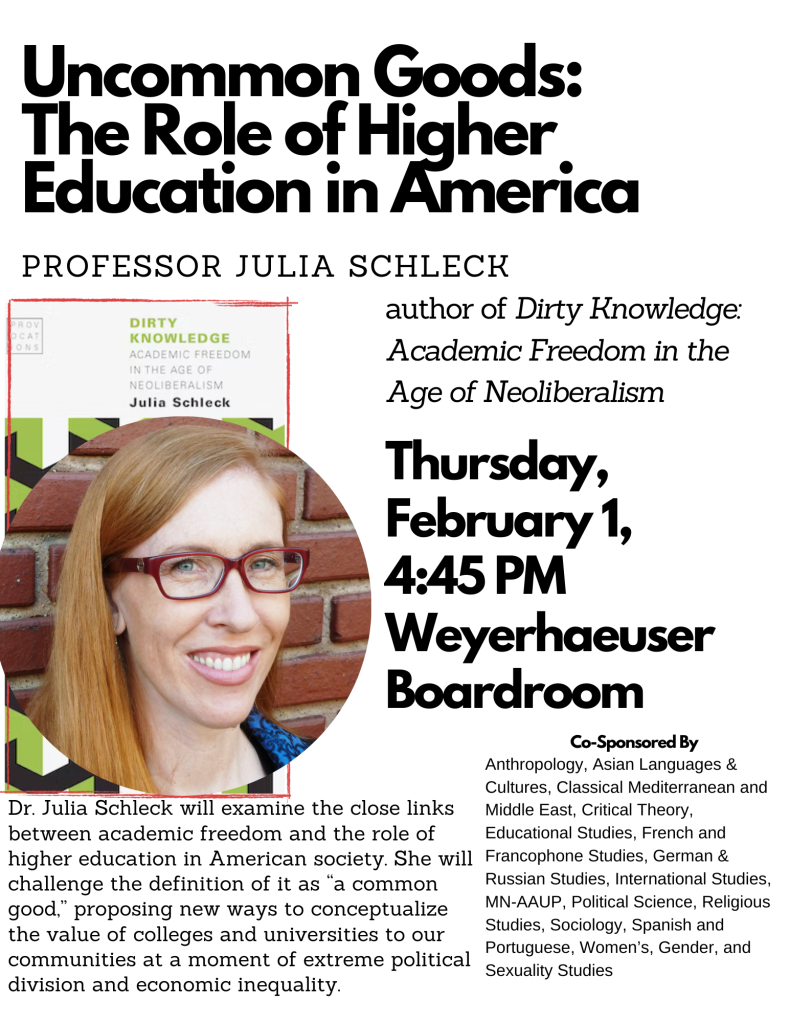
  1. The AAUP, in conjunction with the AAUP Minnesota State chapter and thirteen academic departments, sponsored a public lecture by Professor Julia Schleck of the University of Nebraska, and author of Dirty Knowledge: Academic Freedom in the Age of Neoliberalism, on academic freedom and the future of higher education to a full house in Weyerhaeuser Boardroom. Over 65 faculty, staff students, and senior administrators attended, including from other campuses.
  2. An information session with AAUP chapter leaders, “Our AAUP, What Is It and What Can We Do Together?” was held on Friday, November 3 from 12:00-1:00 p.m. in the DeWitt Wallace Library, suite 309.

Social Events

  1. Two social events were organized at the beginning and the end of the academic year, for faculty and librarians. We met at Sea Salt on September 24, and at Groveland Tap on April 30. 

Why 10 Mac profs delayed compliance with new background check policy

The Mac Weekly, Macalester College’s student-run publication that covers on-campus news and provides a forum for opinion and discussion of issues pertinent to the Macalester community, provided an excellent report on the delay of 10 professors to comply with the College’s new background check policy.

As the article states (and has been discussed on this blog): “Macalester’s current background check policy requires all employees to complete a background check every five years. Consequences for not completing this screening process include potential termination of employment. Previously, Macalester only required one criminal background check as part of the initial hiring process.

Since its initial rollout in October 2022, faculty and staff have criticized the policy for its disproportionate impact on applicants and employees of color; they have also critiqued how faculty and staff were informed of this policy. The administration’s justification for the policy has not remained consistent over time. Both Provost Lisa Anderson Levy and Vice President for Administration and Finance Patricia Langer stated that this policy is essential for Macalester preserving liability, despite not providing any documentation for their claims. President Suzanne M. Rivera, on the other hand, cited the protection of student safety as her motivation for this policy implementation. 10 tenured faculty members refused to comply with this policy when it was reintroduced in September 2023, after its implementation was paused due to pushback.”

Julia Schleck Lecture at Macalester College

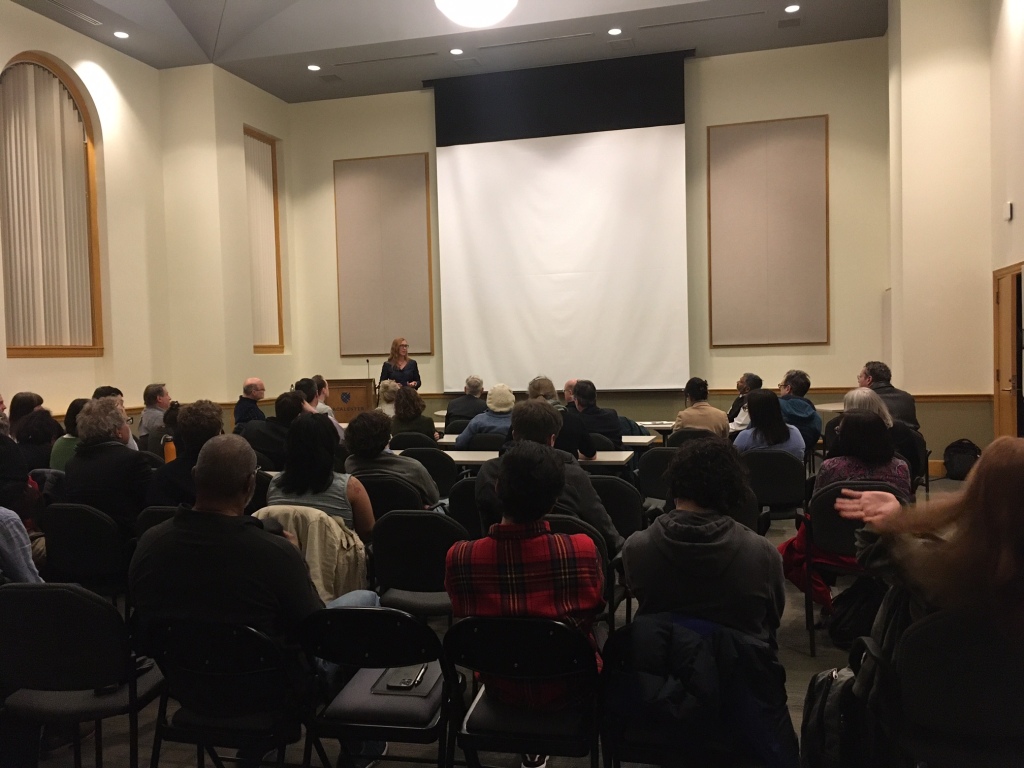
Picture of Dr. Julia Schleck lecturing to a full lecture hall of faculty, staff, students, and senior administrators, at Macalester College.

Professor Julia Schleck of the University of Nebraska, and author of Dirty Knowledge:
Academic Freedom in the Age of Neoliberalism
, gave a challenging and inspiring lecture on academic freedom and the future of higher education to a full house in Macalester College’s Weyerhaeuser Board Room. Over 65 faculty, staff students, and senior administrators attended, including from other campuses.

The interest and eagerness to discuss the real challenges and opportunities that face us in higher education’s future was on full display in the discussion period, which eventually had to be halted for reasons of time, and in the lecture itself.

poster promoting the lecture by Dr. Julia Schleck

Initiated by the Macalester chapter of the AAUP and sponsored by over 13 departments, as well as the state chapter of the AAUP, this event was a great success; we are grateful to Dr. Schleck for accepting our invitation and offering such an excellent talk.

Interpretation of the Faculty By-Laws and Constitution as they apply to the Criminal Background Check

This is the text of the document that the Macalester chapter of the AAUP submitted to EPAG for its consideration as the elected committee of the faculty entrusted with the responsibility of interpreting the Constitution and By-Laws to the faculty. As of December 4, 2023, EPAG had not yet taken a decision on the issue.

Under its authority in the Faculty By-Laws, EPAG has determined that the Criminal Background Check Policy (Employee Handbook, Section 3.2) does not apply to Macalester faculty members because it was not established in accordance with the provisions of the Constitution of the Faculty. By-Law 2.II.B.3.d.ii states that EPAG “serves as the rules committee of the faculty” and “interprets the Constitution and By-Laws to the faculty.”

Rationale for Determination

We consider this issue in light of the fact that at least ten faculty members received an email message on Monday, October 16, 2023 that stated, in part:

Your annual appointment paperwork stated that your employment shall be subject to such rules, regulations and benefits as the college may establish for similarly classified employees, and we previously notified you of the background check requirement for ongoing employment. 

The email message claimed that not complying with the request to undergo the screening constitutes adequate cause for disciplinary action against the faculty member. In short, this email message purports that a criterion for ongoing appointment as a faculty member at Macalester is that individuals have undergone a criminal background check.

Although the college may establish rules and regulations for faculty members, the procedures for doing so must abide by the provisions laid out in the Constitution of the Faculty. Purported rules or regulations that have been promulgated outside of these procedures are null and void: they do not alter the terms and conditions of faculty appointments. Any alleged violation of rules or regulations that have been promulgated outside of these procedures, therefore, do not constitute adequate cause and no disciplinary proceedings against any faculty member should be initiated for alleged violations.

The procedure that established the Criminal Background Check policy fails to meet these requirements. First, they were not brought to EPAG for its consideration under Section 2 II.B. 3.a.ii, which identifies that EPAG has the function to “consider policy proposals upon request of the Board of Trustees, administrative officials, or the faculty. After full consultation and referral to the faculty for approval (if deemed appropriate) recommendations are made in writing to the appropriate body and reported to the faculty.” Second, under the Constitution of the Faculty, the Macalester faculty has primary responsibility for, among others, “the criteria for appointment … of members of the faculty” (Article 1, Section 1.e). Anything purported to be a “requirement for ongoing employment,” therefore, would have to be shown to be supported by the faculty, likely through an affirmative vote of the faculty as a whole. The Criminal Background Check policy as it applies to faculty has not been established in this manner.

The Criminal Background Check policy as currently written contains a further violation of the Constitution of the Faculty. The Constitution indicates that the faculty has primary responsibility for “safeguards relating to dismissal of members of the faculty” (Article 1, Section 1.e). The establishment of a three-person council and procedures to review instances in which aspects of an individual’s criminal record were flagged by the background check process, were developed by members of Macalester’s administration and were not voted on or established by the faculty.

Finally, the Constitution of the Faculty notes that the faculty shares responsibility for “policies concerning … the conduct of members of the College community” (Article 1, Section 2.c). Shared responsibility means that “the President involves the faculty before making final decisions” (Amendment 1). Consultation with the Faculty Advisory Council does not constitute involving the faculty before making a final decision. Furthermore, in this case, there was no consultation prior to adopting the policy that purports to establish undergoing ongoing criminal background checks as conduct required of faculty members. The policy was announced—with no prior indication that such an announcement was forthcoming to any faculty committees or faculty members—in October 2022. In response to faculty criticism, implementation was put on hold, during which time faculty members encouraged members of senior leadership to bring the policy to a faculty vote (which would have addressed these issues). Rather than doing so, the policy was announced to be effective again in September 2023. At no point in the process has the President or other members of senior leadership indicated that they would be open to a decision that resulted in anything other than the current policy, demonstrating that the policy also was not in the spirit of this provision of the Constitution of the Faculty.

The Faculty Handbook establishes the responsibilities of tenured and tenure-track faculty members (Section 3.II.D.1(a), (b), and (c), a copy of which is appended to this document). These responsibilities include teaching, professional development, and service. Nothing in these responsibilities resembles a responsibility to undergo an ongoing criminal background check. Nor is a criminal background check requisite to fulfilling these responsibilities successfully.

In addition to these constitutional grounds for the determination, we note that the history, content, and structure of the Employee Handbook provide further evidence that the criminal background check policy does not apply to faculty members.

The Employee Handbook is a revision of a document that had been entitled Staff Handbook. That Handbook explicitly stated that it did not apply to “those who are appointed to the teaching faculty”. EPAG understands that some of the faculty members who received the October 16, 2023 message were initially appointed at the time when there was no Employee Handbook, but there was a Staff Handbook. Nothing in the Faculty Handbook suggests that the faculty ever accepted that the Employee/Staff Handbook establishes conditions on faculty appointment.

Despite purporting to cover both faculty and staff, sections of the Employee Handbook do not apply to faculty members, as they cover topics that are covered in the Faculty Handbook. Most of these policies are in Section 3 of the Employee Handbook which for years was titled Staff Employment or Staff Employment Policies. Given that the Employee Handbook distinguishes between staff and faculty, it would be logical to conclude that this section of the Handbook was designed to include policies that applied only to staff. Notably, the Criminal Background Check policy is in this section of the Employee Handbook. The title of this section as cited above was changed to Employment Policies and Practices sometime in September 2023; however, no announcement of this section change has been made and no date of change is displayed on any of these pages. We do, however, note that the URL for the Criminal Background Check policy still reflects the previous title (Staff Employment) (emphasis added).

As a whole, the Employee Handbook was (and still predominantly is) designed for staff employees, as evidenced by the fact that it contains an unmodified statement that “Employment at Macalester College is purely voluntary, based upon the consent of the employee and the College. Accordingly, either the employee or the College may terminate this ‘at will’ employment relationship at any time. This handbook does not modify or limit the employment at will relationship.” (1.2 Purpose of the Employee Handbook)

Furthermore, the Employee Handbook includes language that states “The College has the right to change, modify, delete, deviate from, or add policies and procedures [in the Employee Handbook]… These policies and procedures and any subsequent revisions do not constitute an employment contract, and should not be interpreted as creating an employment contract” (1.2 Purpose of the Employee Handbook). Both of these claims do not apply to faculty members, for whom the Faculty Handbook serves as an Employment Contract, which supersedes the Employee Handbook and which gives faculty primary responsibility for substantial aspects of faculty employment.

These fundamental inaccuracies in the content and structure of the Employee Handbook undermine the claim that it is binding on faculty members, providing further support to our conclusion that the Background Check Policy as currently written does not apply to Macalester faculty members and should not be the basis for any disciplinary action.

EPAG considers this determination about the status of the Criminal Background Check policy against a wider background in higher education in which challenges to shared governance continue to emerge. EPAG—and we believe the faculty as a whole—is resolved in the matter of criminal background check policy to work with the administration in doing what is for the good of Macalester and its students by employing our established processes rather than observing those processes in the breach.


Extract of relevant portions of Faculty Handbook

3.II.D.  Faculty Workload and Responsibilities

The responsibilities of a faculty member are multifaceted and no simple definition of the faculty workload is possible to articulate fully. A full workload normally includes teaching courses, supervising independents and honors projects, service to the community, committee service, and professional development activities. When in a full-time appointment, any faculty member considering extensive consulting work or off-time campus employment must discuss such arrangements in advance with the Provost.

1.         Tenured and Tenure-Track Faculty

a.         Teaching

Full-time tenured or tenure-track faculty members normally teach five four-credit courses per year plus engage in other non-classroom instructional activities such as the direction of honors and independent study projects. These courses may be taught 2-3 or 3-2 at the preference of the faculty member subject to the approval of the department chair. There will be variances from this norm for such reasons as absence of the expectation of other instructional duties, sabbatical leaves, service as chairs of departments or of major committees, a disproportionate number of students either in regularly scheduled classes or independent instruction courses, and alternative teaching responsibilities such as the supervision of laboratories or co-curricular activities such as debate or artistic performances. In no case is a variance to be granted or renewed automatically. Variations are to be proposed by the department chair in consultation with the concerned faculty member and expressly approved by the Provost. Department chairs will indicate any proposed variances in their annual proposals for class schedules.

All faculty will observe office hours that are sufficient and varied enough for reasonable access by their students and advisees. Office hours should be clearly posted. All tenured or tenure-track faculty after their first year of appointment are expected to serve as advisors.

b.         Professional Development

Macalester faculty members are expected to conduct an active program of personal professional development. Appropriate activities include scholarly research contributing to the advancement of knowledge, study related to the development of new courses and pedagogical innovations, and participation in scholarly and professional associations. No specific expectations can be devised to meet the differing circumstances of all faculty members, but the occasion of the annual report to one’s department chair and the Provost could provide opportunity to determine the suitability of professional development programs in each individual case.

c.         Service

Macalester faculty members are expected to be actively involved in College and professional service.

All tenured or tenure-track faculty after their first year of appointment are expected to accept nomination for or appointment to faculty and College-wide committees. Only tenured faculty are eligible for nomination to the Faculty Personnel Committee. Typically, nomination to the Educational Policy and Governance Committee or the Strategic Planning and Analysis Committee is not recommended until after faculty have undergone a successful pre-tenure review at the College. Faculty who complete full terms on one of the standing committees or a term as presiding officer or secretary of the faculty will not be expected to assume standing committee responsibilities for the year following that service.

Macalester AAUP Supports the Staff Union of the AAUP

October 31, 2023

The Macalester All-Campus chapter of the AAUP stands in solidarity with the staff union of the AAUP, as they begin a rolling series of one-day strikes. We recognize that the strength of the AAUP is not advanced by internal inequities that divide us while simultaneously seeking protection and advancement for its membership.

In supporting the AAUP’s staff union on principle, we note that the first group to strike today is the AAUP’s Department of Academic Freedom, Tenure, and Governance. These are the core values of the AAUP and are precisely the basis on which much of our own chapter’s activity over the last three years has been based: protecting our faculty handbook and our involvement in the shared governance of our institution, and defending academic freedom and the protections of tenure, as created and defined by the AAUP. We do not see how we can fail to support the staff union that supports our core work.

We call upon the AAUP leadership team to instruct their bargainers to immediately return to the bargaining table in good faith, to return to their previous, more generous bargaining position, and to quickly resolve this dispute to support members of the staff union who do so much to advance our collective work. 

We encourage our own membership to contact the AAUP leadership team to encourage them to return to the bargaining table in good faith and return to their prior bargaining position. We include contact information below shared by the US-AAUP so you can email them more easily. 

In solidarity,

The Macalester All-Campus Chapter of the AAUP

From the US-AAUP team:

If you’re an AAUP member or leader, you can take action. If you haven’t already, please email members of the Council; tell them you support the strike and it’s time to bargain in good faith and settle a contract. Thank you for all of your support!

Here is the Council’s contact information (you can copy the list directly into the send line of your email; Council members’ full information is listed below.)

irene.mulvey@gmail.com, davisp1971@gmail.com, sinclair@aaup.org, longa@law.unm.edu, nmajumdar@pscmail.org, rawlsg@yahoo.com, antonio.gallo@csun.edu, karosemb@umd.edu, dmurch@history.rutgers.edu, davarian.baldwin@trincoll.edu 

Irene T. Mulvey, President (2024), Mathematics, Fairfield University (retired)
Paul Davis, Vice President (2024), History and American Government, Cincinnati State Technical and Community College
Christopher Sinclair, Secretary-Treasurer (2024), Mathematics, University of Oregon
Ernesto Longa (2026), Law/Library Science, University of New Mexico
Nivedita Majumdar (2024), English, City University of New York, John Jay College
Glinda Rawls (2024), Counseling, Western Michigan University
Antonio Gallo (2026), Ethnic Studies, California State University, Northridge
Karin Rosemblatt (2026), History, University of Maryland, College Park     
Donna Murch (2026), History, Rutgers University 
Davarian Baldwin (2026), American Studies, Trinity College

Letter to Macalester Faculty regarding the latest Provost communication regarding the proposed Criminal Background Check Policy

Dear Colleagues,

You will by now have seen the letter from Provost Lisa Anderson-Levy regarding the update on ongoing criminal record checks sent on Thursday, September 28. Some of you have contacted the AAUP with questions about where things stand and what next steps are possible.

The AAUP has had several conversations with members of the college administration about our concerns. Many of the concerns we raised were included in a summary that the AAUP chapter circulated earlier in September. Additionally, we suggested changes to the college policy that would minimize its potentially negative consequences while also shielding the college from liability risk. Unfortunately, our suggestions thus far have not been incorporated into the policy, although members of the administration have indicated an ongoing willingness to discuss these issues. 

The AAUP also raised concerns about how the policy has been developed outside of the Faculty Handbook in a manner that raises serious concerns about governance and the terms and conditions of faculty employment. These concerns remain an open issue and one on which members of the administration also indicated an interest in continued conversation.

Our staff colleagues have little choice but to comply with the administration’s policy, which we believe is harmful.  Unlike staff, TT/T faculty are not at-will employees. Faculty whose original letters of appointment do not require a background check are entitled to decline to undergo one. The conditions under which we as faculty are hired are stated in our initial letter of appointment and that has legal force. The hiring of faculty before 2016 was not conditional on successfully completing a criminal background check, and for the College to now impose that condition requires our assent. Although the College policy states that disciplinary action will be taken, according to the procedures laid down in the faculty handbook, against faculty who decline to undergo a criminal background check, a refusal to undergo a background check is not a disciplinary matter under the meaning of cause in the handbook. It is a contractual dispute, in which neither the FPC nor the FAGC has a role. 

We understand that there are members of the faculty who will not consent to the check in the coming weeks. We also understand that there are some members of the faculty who are still considering whether to do so. There will be faculty members who are on sabbatical or other leave who do not authorize the check during the 10-day period. There may be others who simply forget to do so. 

For our part, we  believe that before the faculty agrees to undergo a background check, substantial revisions must be  made to the policy along the lines which the AAUP has suggested. The College has put in place an onerous and poorly thought out policy (see the summary of the shortcomings referred to in our annual chapter report) that negatively impacts our staff colleagues, who, unlike us, have no choice but to comply. Moderating the worst aspects of this policy is in the best interests of the college and all of its employees, and the faculty should be firm in making that case. 

No matter your individual circumstances, please reach out to the Macalester AAUP chapter for whatever support you need. We will continue to work to address the shortcomings in this policy.

Macalester AAUP Annual Report, 2022-2023

The Macalester Chapter of the AAUP is an inclusive and democratic organization whose goal is to promote academic freedom and shared governance on campus, and to be an advocate for matters that concern the faculty. The principle of academic freedom and the institution of tenure, and the principle of shared governance, have been introduced into American higher education as the direct outcome of the AAUP’s advocacy and organizing since 1915. Faculty handbooks across the country today reflect the AAUP’s policies and values, and enshrine these principles. The history of the AAUP at Macalester goes back to the 1930s; the current chapter was established in 2019. 

Membership is open to all faculty and librarians; our current membership is 30. The work of the chapter is driven by member initiative, either brought to the attention of the membership at a general meeting or communicated directly to the chapter officers. While there are some tasks that officers take on without publicity, especially assistance and support to individual faculty, most of the chapter’s direction is a result of member request. As we describe below, the AAUP seeks to work through the elected committees of the faculty to achieve its objectives, but on occasion, under certain circumstances, also works on its own. Members of the AAUP also serve on elected committees of the faculty in their individual role as faculty members.

This report summarizes the work of the chapter during the academic year 2022-23. Much of our work centered on governance issues, mostly driven by the failure of the administration on a number of occasions to observe procedure as laid down in the faculty handbook. Our members also acted as formal advisers, according to procedure, for faculty colleagues involved in disciplinary measures. We also organized events to facilitate faculty discussion of matters of shared interest and concern.  

Governance Issues

1. Faculty Handbook language on disciplinary procedures. The AAUP has been working since the summer of 2019 to revise and re-order the disciplinary procedures for tenured and tenure track faculty in the faculty handbook. This work was brought to a successful conclusion at the faculty meeting of March 7, 2023. In 2019, the AAUP discovered that the Handbook contradicted itself at several points on procedure, made reference to sections that did not exist or had been mislabeled, made reference to external documents (the AAUP policy) whose language the faculty did not control, and in general was structured in such a way as to make it difficult to determine its meaning. An AAUP committee worked on revising the Handbook’s language to bring order and clarity to it, and we also advocated that the AAUP’s language on disciplinary procedures be incorporated into the Handbook. We submitted these proposals to EPAG in the Fall of 2019, which brought them, after additional revision, to the faculty in two stages. On May 11, 2021, the faculty voted to adopt language clarifying the procedure to be followed, and to adopt language defining what constituted cause for termination of tenured faculty (which had been lacking in the Handbook). On March 7, 2023, the faculty voted to make the AAUP’s disciplinary procedures part of the language of the Handbook itself, thus bringing that language under the control of the faculty.

2. MNI issue. In January 2022, Macalester announced a $1 million Mellon grant to support the Macalester Native and Indigenous (MNI) Initiative, a highlight of which would be four postdoctoral scholars, with the “long-term goal [. . .] to retain [them] through appointment to tenure-track positions.” On June 17th 2022, an announcement was circulated to all faculty describing the application procedures for the first two of the four postdocs. However, that announcement suggested a connection between the postdocs and future tenure-track allocations that bypassed the procedures for allocating tenure-track positions established in the faculty handbook. Information provision, relevant elected committee deliberation, and all-faculty consideration of this major curricular addition were either inadequate or missing. 

The AAUP raised its concerns in a memorandum sent to members of the administration as well as EPAG and FAC.  The concerns, available in more detail in the memorandum, included: (1) the process through which the lines were requested and approved; (2) the use of EPAG to approve allocations, rather than the Allocations Committee to recommend them; (3) the approval of future allocations when the availability of such allocations was not yet known; and (4) the scale of the commitment of resources in ways that bypass the normal governance process that gives the faculty primary responsibility for curricular decisions.

The issues detailed in our memo were extensively discussed by EPAG, which announced at the December 2022 faculty meeting that the MNI post-docs would be decoupled from the allocations process, the decisions on post-docs being made by the provost and the steering committee of the MNI grant with no promise of a TT position to follow. Departments that had received post-docs would be free to request an allocation in the usual way.  

3. Criminal Background Check Policy. During Fall 2022, following an email message announcing that the college was adopting a new criminal record check policy, the AAUP developed material analyzing the potential consequences of this policy, which it shared with members of the faculty and administration. A majority of full professors on campus signed on to a letter expressing many of our concerns. Subsequently, the policy’s implementation was put on hold and a series of discussions followed. In May 2023, after ongoing discussions, the policy was revised. 

Despite the policy revisions, several concerns about the policy remain. The concerns include: 

  • a lack of transparency about what insurers require and why; 
  • that the policy treats faculty as if they were at-will employees; 
  • that the policy could exclude from employment people who have not been convicted of crimes; 
  • that the policy does not mitigate the harms of excluding people with criminal records from employment by using the protections that are offered to employers under Minnesota law; 
  • that the policy retains language that would allow for withdrawal of employment on the basis of a subjective judgment about reputational risk which is contrary to AAUP guidelines; 
  • and that the policy contains unnecessarily ambiguous language.  

A fuller discussion of these concerns is available here. AAUP members continue to work to address these concerns productively in ways that will protect both the college and faculty, staff, and applicants. 

4. Faculty appointment letter. The AAUP issued a statement pointing out that the two conditions laid down in the faculty appointment letter of May 31, 2023 regarding annual salary increases were not supported by Minnesota law nor by the Faculty Handbook. We urged the administration to withdraw this attempt to make salary increases contingent on (a) a supposed legal requirement to sign the notification, and (b) on acceding to a criminal background check. The administration accepted our position and did so.

5. Course cancellation policy. The AAUP wrote to the Dean of the Faculty to share concerns about the college’s course cancellation policy. We pointed out that the practice threatened in the past of arbitrarily reducing the salary of record of a member of the faculty in the event of canceling their class (followed or threatened by the previous administration, although, as far as we know, not by the current one) was likely illegal under federal law, which prohibits singling out an individual or individuals for a reduction of salary (see Fair Labor Standards Act) and by the provisions of the Faculty Handbook, which contains no provision that allows the administration to penalize an individual faculty member for failing to reach a minimum enrollment target set by the administration. We also shared concerns about the policy from a pedagogical and equity standpoint.

6. Title IX and disciplinary issues. Members of the AAUP were approached to act as advisers to faculty in (1) a Title IX process resulting from student harassment of a faculty member, and (2) in a disciplinary hearing. Two members of the AAUP served as an adviser to each of the faculty members concerned. Both issues were satisfactorily resolved.

Issues related to Academic Freedom and Speech on campus

7. Censoring the Taravat exhibition. The AAUP issued a statement expressing our concern about the administration’s censoring of the Taravat exhibition at the Lew Warschaw Gallery. In the spring semester of 2023, following an incident at Hamline University where an instructor was falsely accused of Islamophobia, some students at Macalester complained about an art exhibit on campus by the Iranian American artist Taravat Talepasand, whose work responds to the contemporary uprising by Iranians against that country’s theocratic regime. Those students found some of the material on display objectionable and lobbied to have the exhibition closed. In response, the college “paused” the exhibit for several days and veiled the glass walls of the gallery with black curtains to prevent people seeing in. The college thereafter re-opened the exhibit, with the curtains removed, but replaced by other barriers to prevent people outside the exhibition space from seeing the offending art “non-consensually.” We were concerned by the disregard for our own artistic/conceptual vision in the gallery’s open design that the administration’s actions indexed, and by the administration’s disregard for the principle of artistic freedom and the freedom of speech, which should be a pre-eminent value in any institution of higher education. As an institution of higher learning, it is Macalester’s responsibility not only to promote debate and the untrammeled exchange of ideas, but to model how that should take place for all members of its community and for the public at large. We believe that in this instance, Macalester’s actions undermined both those goals.

Other activities

8. Disability Services. We invited the new Director of Disability Services Shamma Bermudez to attend a monthly meeting to present and answer questions on the topic of accommodations in Fall 2022. We are grateful to Director Bermudez for attending.

9. The AAUP organized an Academic Freedom and Identity Politics Reading Group during the spring semester to read and discuss two recent books: Olufemi Taiwo’s Elite Capture: How the Powerful took over Identity Politics (and everything else) and Julia Schleck’s Dirty Knowledge: Academic Freedom in the age of neoliberalism. Fifteen people participated.

10. Meetings: we held meetings monthly during the academic year, on the Wednesday following the faculty meeting (meetings are at 4:45 p.m. in Carnegie 06A), with a slowly-rising attendance. Administratively, we created the digital infrastructure for the branch’s record-keeping: we created an independent email and google drive account with our chapter’s files secured off-site. We created the google discussion list and the wordpress website, and began posting content to the site. The highest weekly site visit we had was 276.

11. Social Events. We organized two social events at Sea Salt, in Minnehaha Park, in the Fall and Spring for faculty and staff to meet, socialize, and discuss matters of shared interest. Members of the faculty and librarians are invited to join us for the next AAUP social on September 24 at Sea Salt at 5:30 p.m. Learn about the AAUP and share your ideas and concerns.

Macalester AAUP Statement on Revised Criminal Background Checks

September 8, 2023

This statement summarizes continuing concerns with the college’s revised criminal record check policy. The policy was revised in May 2023, although to our knowledge, no announcement about this revision has been made. A longer version of this statement was shared with members of the administration and the Faculty Advisory Council and is available upon request. 

1. Continued Concerns about the Transparency of the Origins of the Change in Policy

Initially, members of the administration stated that the college’s insurance provider required the college to adopt an ongoing record check policy to be able to renew our general liability insurance. More recently, however, there has been a shift: the claim has become that the college’s insurance broker states that we will need to have the policy to secure coverage. 

Shortly after the announcement of the policy change last fall, the Macalester AAUP chapter and faculty and staff members of the college requested documentation to show that changing the policy was a requirement for coverage. After several months, the administration provided portions of two application forms (or warranty statements). Those statements suggest that, to the extent that the college is required to have a record check practice, that it has latitude to how it structures the policy.

Neither of these warranty statements indicates a requirement for having a particular background or record check policy. Both are merely part of an application, similar to what many of us might complete for a homeowner’s insurance policy. The mere existence of items on a form does not indicate that they are a requirement for coverage. 

There is, however, the possibility that a warranty statement previously completed by somebody at the college stated something about the college’s practice of criminal record checks that was inaccurate. If that did happen, could that be the reason that Macalester has to change the policy to now do what the college said it had been doing? If so, the transparent response would be to say that is the reason. If it is not the case, then the College should produce  documentation that there is a requirement for ongoing record checks.

2. Concerns That the Policy Incorrectly Treats Faculty as At-Will Employees (and Implications for Ways to Improve the Policy)

A policy based on the idea that tenure-track and tenured faculty are at will employees has no basis to be enforceable. Once hired into a tenure-track or tenured position, faculty employment is governed by the Faculty Handbook, and employment is not at will. Yet, the policy as announced states that if a record check reveals certain criminal convictions, a faculty member could be terminated.

Presume that a tenured faculty member consents to a record check and the check reveals that the faculty member was previously convicted of a crime. If that faculty member’s transgression was not a part of their duties at Macalester, there may not be grounds to terminate that individual. The state, having found that person guilty, would have imposed a criminal sentence. If that criminal sentence did not involve incarceration or community supervision with severe restrictions, that individual would still be able to fulfill their institutional responsibilities. Furthermore, the state’s decision about punishment would imply that the individual continued to be fit to live and work in the community. If the individual had completed any criminal sentence and was not currently under correctional supervision, these considerations would be magnified. In short: the situation would be one in which none of the grounds for termination under the Faculty Handbook would apply.

Presuming that the college concluded that the individual still posed an additional liability risk, a more productive, legally defensible, and humane response than seeking termination would be for the college to work with the individual and any supervisors to develop a risk mitigation plan. 

If we can imagine mitigating risk without termination in a situation in which a tenured faculty member with a previous conviction cannot be terminated, we should also be able to imagine doing something similar for staff members or potential employees. Such a response would be more in-line with the college’s values and with the commitments that we have made to redressing the inequities that have resulted from systemic racism, including the overcriminalization of disadvantaged people and communities.

3. Macalester Has Substantial Legal Protections That Should Inform the Policy

Minnesota Statute 181.981 unequivocally states that an employee’s criminal record will not be admissible for liability if the record did not result in conviction (Subd. 1(3)) or if the duties of the position do not create a risk greater than the employee being in public or employed in general (Subd. 1(1)). The provisions of Subd. 1(3) mean that Macalester’s policy could refer only to convictions (not arrests, charges, or pending charges) without creating additional liability risk for the college. The provisions of Subd. 1(1) mean that there may be positions at the college for which having a criminal conviction could pose no or minimal risk (and for which mitigation measures as suggested above could suffice). Courts in Minnesota have also repeatedly upheld the principle that merely hiring or retaining an individual who has a criminal record does not create liability for employers.

4. While the May 2023 Policy Revision has Some Positive Changes, It Also Introduced Additional Shortcomings

The policy has changed to state that certain convictions “may” (rather than “will typically”) result in the withdrawal of an offer of employment. In addition, the revised Q&A document clarifies that the college will review the last seven years of record check results (which is in line with the evidence-based best practices). Both changes improve on the policy as initially circulated, although moving the language about the seven-year time frame into the policy would strengthen those protections, as would limiting requests for information to a third party vendor to that time frame. 

Other changes (and non-changes) to the policy point to continued shortcomings. Despite a recommendation to remove language under the heading “Relevancy of Convictions” relating to charges, that language has not only been retained but has now been incorporated into that section to state: “A conviction, charges, or pending charges will not automatically preclude…” (replacing “A conviction will not automatically preclude….”). If the policy were limited to just convictions, it would give the college full protection of liability under Minnesota law. Adding “charges or pending charges” suggests that having been charged with a crime could preclude an individual from employment consideration. An individual charged (but not convicted) has not been found guilty (and  we all have acknowledged  that criminal charges are influenced by systemic racism and other biases).

Similar concerns are raised by a change that clarified the meaning of an ambiguous term (“encounter with law enforcement”) but did so in an overly expansive way. The policy now reads “If an employee is convicted of a crime, charged with a crime or has a pending criminal charge…,” they should provide notification to Macalester. Simply put: a charge or pending charge does not prove that a person engaged in the alleged behavior and, accordingly, Minnesota law says that information about the charge or pending charge cannot be used in a suit against the college for negligent hiring or retention. Including that language raises the risk that an individual who has not been tried may suffer an adverse employment outcome, violating the cherished principle that we presume people are innocent until proven guilty.

5. The Policy Continues to Include Problematic Grounds for Withdrawal of Employment 

The policy allows withdrawal of an offer of employment if something in the record “possibly impugns the reputation of the college.” The language is vague and subjective and allows decision-makers to exclude candidates even if their actions would pose no threat to safety or security. This clause also runs afoul of guidance from the AAUP which has deemed damage to the reputation of an institution as an inadmissible ground for termination.

6. There are Several Items that Remain Ambiguous that Could Be Clarified Easily or that Incorporate Overly Broad Language that Could be More Specific while Still Protecting Macalester

Without detailing each point in the policy, we note that there remain ambiguous phrases that offer little guidance to managers, applicants, and staff and faculty at Macalester. Examples include references to “successful” or “not successful” background checks (without defining success), an applicant’s duty to “disclose relevant information” (without identifying what information is relevant), and statements about how the recurring record checks will be interpreted by “guidelines provided by this policy” (without addressing the specific guidelines that will be used or how they will be adapted to retaining, rather than hiring). In addition, the policy language does not reflect representations given by members of the administration that there are some convictions for crimes that would not be of interest to the college (for example, convictions related to protest activities). 

To conclude: we understand the concerns that the college has about liability for negligent hiring and retention. Yet allowing those concerns to dictate our practices without considering ways that we can mitigate the real harms of excluding people from employment who have been caught in the net of criminal law enforcement and punishment would have Macalester contributing to, rather than seeking to reduce, injustice. We should make use of the protections that law currently affords us to do what we can to address the ongoing harms that people who have been subjected to criminal prosecution face even after having charges dropped or after completing any criminal sentence. We also must not allow those concerns to interfere with the commitments that we have to faculty and staff already at the college. 

Macalester AAUP Statement on Provost’s Email Regarding the Faculty’s Salary Increase

June 11, 2023

The Macalester AAUP is deeply concerned about the May 31, 2023 email with the subject heading “Faculty Contract Information” from the Provost regarding annual salary increases. This email asserts, without any foundation in state or federal law, or in the Faculty Handbook, that faculty (and presumably staff) must sign the PandaDoc that will be sent informing them of the salary increase, because “written acknowledgement of a change in salary is required by Minnesota law.” It also requires faculty to accede to a criminal record check policy that was announced in October. Many on campus objected to this criminal record check policy when it was first announced, and the administration has conceded that the initial policy circulated at that time requires changes. We are concerned that the conditions specified in the provost’s email circumvents the governance and communication procedures that the administration previously committed to follow with respect to the criminal record check policy. Furthermore, withholding a faculty member’s salary increase is defined in the Faculty Handbook as a severe sanction, which may not be unilaterally imposed by the administration. Accordingly, we urge the administration to withdraw this attempt to make salary increases contingent on (a) a supposed legal requirement to sign the notification, and (b) on acceding to a criminal background check.

(a) The administration’s claim that we are required by law to sign the salary notification is not supported by the Minnesota statute and is unwarranted and coercive. The Minnesota Wage Theft Prevention Act of 2019 (181.032 (d), (e), and (f)), requires employers to provide notice in writing (the statute does not call this a contract) of an employee’s pay at the start of employment, and keep a copy signed by the employee acknowledging receipt. The employer must also provide notice in writing of any subsequent changes to an employee’s pay. However, the law does not require the employee to sign and return these subsequent notifications. In claiming that it does, the provost’s email communication errs.

The Faculty Handbook provides (3.VIII.A.10) that “The Provost will issue annual letters of continuing appointment for all eligible tenure-track and tenured faculty members. These letters will serve as salary notification letters for the following academic year.” This provision is extended to continuing non-tenure track faculty (3.VIII.B.3). The Handbook does not define these letters of continuing appointment and salary notification as contracts either, nor does it require that they be signed and returned as a condition of receiving the salary increase.

(b) Linking salary increases to a demand to submit to a criminal record check violates three provisions of the Faculty Handbook, which defines the terms of the faculty’s employment, and which the college is contractually bound to observe:

  1. Section 3.I.B.4 (at p. 28, online version of Handbook) reads: “The precise terms and conditions of every appointment will be stated in writing and will be in the possession of both Macalester College and the faculty member before the appointment commences.” If the requirement of a periodic criminal record check is not included in the initial letter of appointment, then the administration may not require it as a condition of future service or as a condition to receive salary increases (see below).

  2. Section 3.VIII.A. (at p. 71, online version of Handbook) deals with Annual Salary
    Review Procedures. Nowhere in that section is it stated that (a) a salary notification must be signed and returned and (b) a faculty member must submit to a criminal record check, to receive salary due to them. To impose these conditions violates the faculty handbook. If, as a consequence of the policy enunciated in the provost’s email, harm is caused to one or more faculty members (e.g., by withholding a raise due to them), that would be adequate grounds for legal action.

    In particular, we draw attention to Section 3.VIII.A.2: “Assuming the availability of funds, all tenure-track and tenured faculty will receive an across the board salary adjustment.” This provision is extended to continuing non-tenure track faculty (3.VIII.B.1) and to faculty in MSFEO (3.VIII.B.2).

  3. Section 3.VII.B.3.b (at page 68, online version of the Handbook) defines severe sanctions (as part of the college’s disciplinary procedure): “Examples of severe sanctions other than dismissal include suspension with or without pay, reassignment of duties, removal from leadership positions, foregoing salary increase and/or benefit improvements, restrictions on the use of campus facilities, and mandatory counseling and/or monitoring of behavior and performance.”

    Section 3.VII.B.3.a establishes that any disciplinary action that could result in a severe sanction must follow an established procedure. Accordingly, the administration may not withhold a salary increase from a faculty member unilaterally.

For the reasons adduced above, we urge the administration to withdraw this ill-considered action.

The faculty and staff are both entitled to this salary increase, as well as to respect from the administration. Making this salary increase contingent on accepting these legally suspect conditions is poor governance practice on the administration’s part, and demonstrates a lack of respect for the college’s employees.

Any member of the faculty who is concerned about harms they may suffer due to the threat to withhold the 4% raise due them, should contact the Macalester Chapter of the AAUP. We will vigorously support any of our colleagues who declines to accede to the conditions laid down in the provost’s email.

Design a site like this with WordPress.com
Get started